Select a case study
Choose a case study from the list on the left to read about real-world results achieved with Accutrak Group technology.
Ore Flow Visibility Across an Entire Underground Gold Mine
Deep-Level Gold Mining | South Africa
The Challenge
One of South Africa's largest gold mines operates a highly complex underground ore handling chain: rail-bound locomotives, trackless mobile machines (TMMs), conveyor belts and skip hoisting systems all running simultaneously across multiple levels and sections. Each system reported independently, or not at all, leaving management with no consolidated view of how ore was actually moving through the operation.
Without the ability to reconcile tonnes across transport modes, production losses in the ore handling chain were nearly impossible to locate. Utilisation data was fragmented, bottleneck analysis was done in hindsight, and shift reporting depended on manual tallying rather than instrumented data.
What We Deployed
Accutrak Group instrumented all four ore handling systems within a single, unified monitoring architecture:
- Smartrail was deployed on all rail-bound sections, capturing trip-by-trip tonnage and loco utilisation across every locomotive consist.
- Conveyor belt scales were installed at all key transfer points, providing continuous flow measurement between sections.
- Trucktrak was fitted to the TMM fleet, tracking payload and utilisation for every vehicle underground.
- SCADA integration brought the skip hoisting system's cycle data into the same environment, completing the ore path from stope to surface.
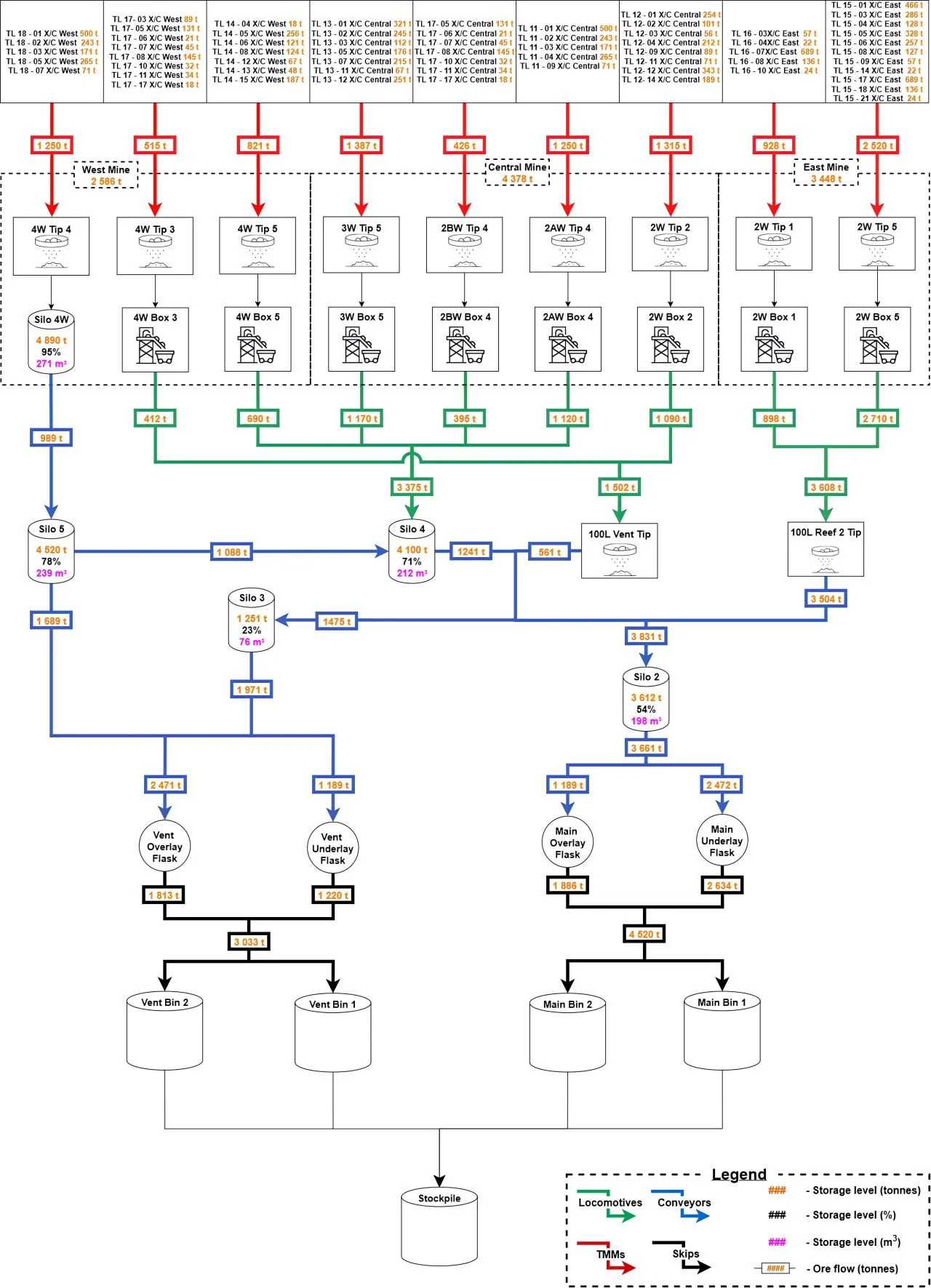
All four data streams were consolidated into a live ore flow schematic, updated in near-real time, showing active tonnes at every node in the system: crosscuts, ore passes, silos, flasks, conveyor belts and bins, all the way to the surface stockpile.
The Result
For the first time, the mine had a single live view of ore movement from stope to stockpile, across all four transport modes simultaneously. Tonnage reconciliation became a real-time activity rather than a post-shift exercise. Utilisation was visible at both individual system and consolidated operation level, something that had never been achievable before.
Bottlenecks that had previously been invisible in aggregate data became immediately apparent. The ability to pinpoint exactly where ore flow was constrained, and to act on it within the same shift, represented a fundamental change in how the mine managed its underground ore handling chain.
"A consolidated tonnage and utilisation view across trains, TMMs, conveyor belts and skip hoisting, at both individual system and operation level, something that was never possible before."
Related products: Smartrail | Conveyor Belt Scales | Trucktrak
Bringing Live Tramming Performance Underground
Underground Rail-Bound PGM Mining | South Africa
The Challenge
A large underground PGM mine had Smartrail installed throughout their underground operation and was getting excellent value from the data. Production managers on surface could track trammed tonnes per shift, monitor loco performance and measure section output against call. The system had become trusted enough that shift bonuses for miners and loco operators were paid directly on Smartrail-monitored tonnage.
The problem was that all of this insight was only accessible on surface. The screens and reports never made it underground, where the actual tramming happened. Operators had no visibility of their own performance while they were on shift. A loco operator finishing a shift had no way of knowing whether they had hit target, fallen short or had time for one or two more trips. They would only find out after surfacing, when it was too late to do anything about it.
What We Deployed
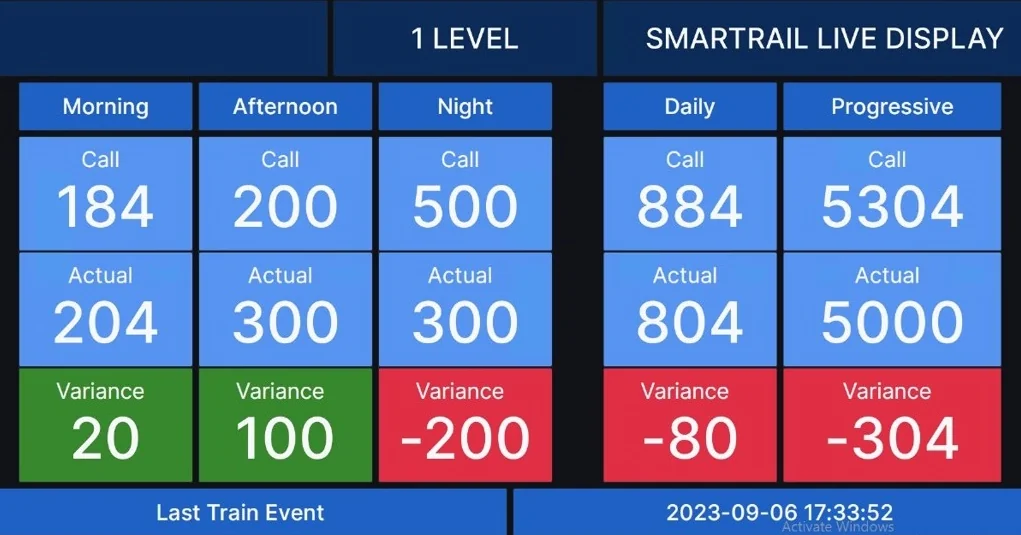
The request came from the miners and loco operators themselves: put the numbers where we can see them. Accutrak Group developed and installed Smartrail Live Display screens at the underground tips on each level. The screens pull live data directly from the Smartrail system and display, per shift, the tramming call, actual tonnes delivered and the variance, updated after every train event.
At a glance, any operator approaching the tip can see exactly where their level stands against target. A green variance means they are ahead. A red variance tells them by how much they are short, and whether one or two more trips would close the gap before the shift ends.
The Result
Operators stopped finishing shifts not knowing where they stood. The live display turned individual performance into something visible and actionable while there was still time to respond. Mines reported a meaningful improvement in shift-end tonnage as operators who could see a small negative variance in the final hour pushed to close it, rather than discovering the shortfall on surface.
The feature resonated across the industry. Smartrail is now installed on over 40 mines, and more than five of those have placed Live Display screens throughout their underground tips, making level-by-level performance visible to every person on shift.
"The request came from the operators themselves. They wanted to know if they could do one more trip to make target, not find out they missed it by a small margin after surfacing."
Related products: Smartrail
From Data Reconciliation to Bottom-Line Impact at a Tier-1 Gold Mine
Open-Pit Gold Mining | Central Africa
The Challenge
A large open-pit gold mine was struggling with a fundamental data quality problem: operator tally sheets used to track excavator loads and dump truck trips were not reconciling with monthly survey data. The gap between what was reported and what the survey showed was significant enough to make production planning unreliable. Forecasting was built on uncertain foundations, and management had no consistent baseline to measure performance against.
What We Deployed
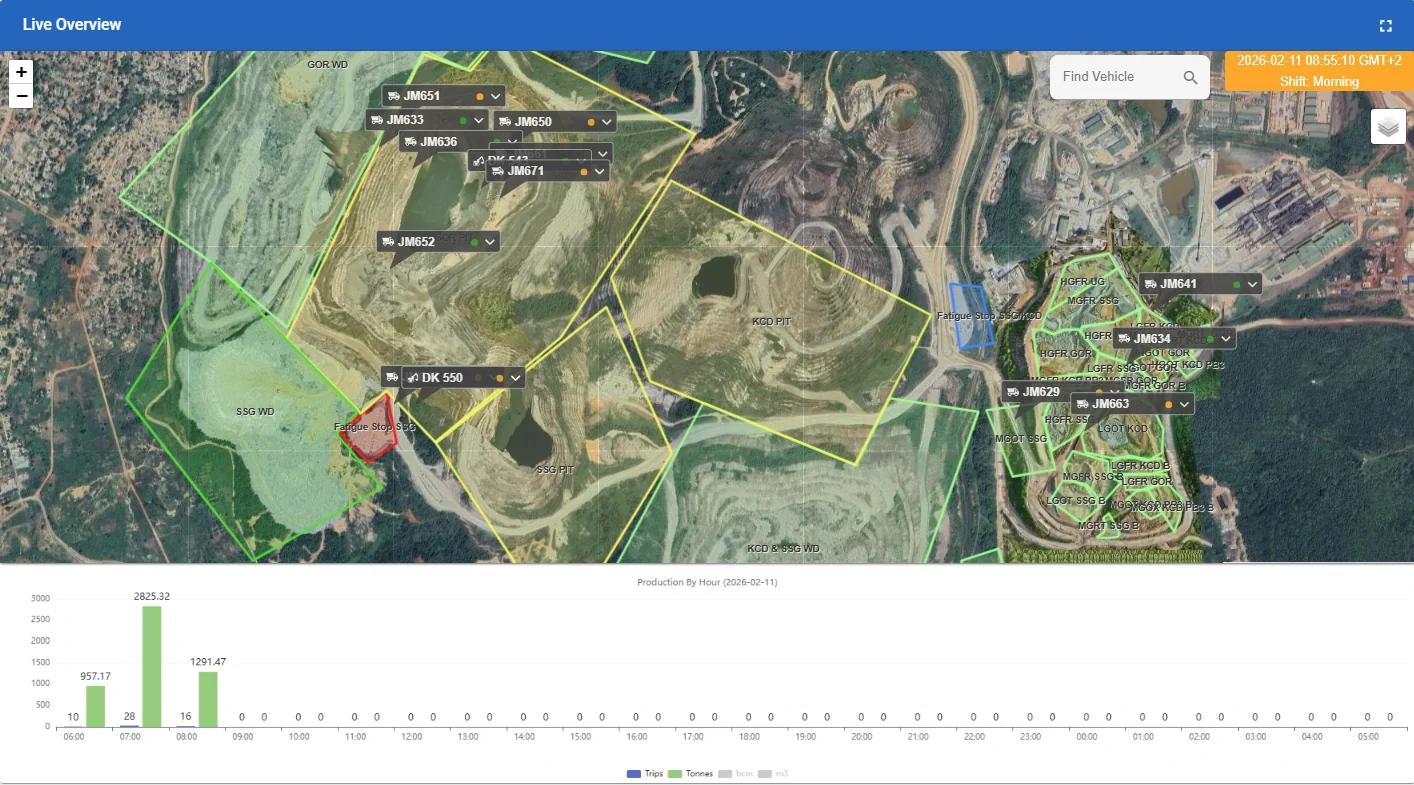
Minegaze was installed across the operation, instrumenting the excavator and dump truck fleet with GPS tracking and production monitoring. Every load was recorded automatically: excavator bucket counts, truck trip counts, and cumulative shift tonnes, all feeding a live production dashboard and monthly progressive reports.
Phase One: Solving the Data Problem
The impact was immediate. Monthly progressive tonnage from Minegaze reconciled directly with survey data, resolving the discrepancy that had undermined planning for years. For the first time, the planning team had a reliable, auditable production record to work from. Forecasting accuracy improved significantly, and the mine could set credible targets with confidence in the underlying data.
Phase Two: The Shift in Focus
With data quality resolved, attention shifted to value. Once Minegaze was providing reliable trip-by-trip data, it became possible to ask a question that had previously been unanswerable: what is the financial value of one additional load in a shift?
The answer, when properly analysed, was striking. At a mine that has passed its daily breakeven point, fixed costs are already covered. Each additional load delivered to the plant contributes revenue against variable costs only (fuel, consumables and processing reagents), making the marginal profit per additional load exceptionally high.
The Numbers
A CAT 777 carries approximately 90 tonnes per load. At a representative ore grade of 2 g/t and a plant recovery of 87%, each load yields approximately 5 troy ounces of gold. At a gold price of $3,300 per troy ounce, that is approximately $16,500 in gold revenue per load.
The variable cost of an additional trip (diesel, tyre wear allowance, consumables and processing reagents) is estimated at approximately $1,500 per load. The remainder goes directly to the bottom line.
On a large surface fleet with a typical ore-to-waste strip ratio, not every truck hauls ore on every trip. The real value lies in the trucks that are falling short of their planned trip count. Each truck that closes a two-trip gap against its shift target contributes $30,000 in marginal profit in that shift alone, without any change to fleet size, mining plan or plant capacity.
Marginal profit per additional CAT 777 ore load: ~$15,000
2 extra trips per truck per shift → ~$30,000 per truck per shift
If 10 ore trucks close a 2-trip gap per shift → ~$300,000 per shift
Across 2 shifts and 330 operating days → ~$200 million per year going directly to the bottom line
Incentivising Performance
Once the value of each additional trip was quantified, the mine introduced a structured incentive programme. Excavator operators were given load count targets per shift; dump truck operators were given trip count targets. The targets were visible in the Minegaze dashboard throughout the shift, giving operators real-time feedback on where they stood.
The result was a measurable and sustained behavioural shift. On average, dump truck operators completed two additional trips per shift compared to the pre-incentive baseline. At the marginal profit rates described above, this represents one of the highest-return interventions available to a mine that has already invested in its fixed cost base.
"Once fixed costs are covered, the value of every additional load is almost entirely profit. Two extra trips per truck per shift is not a small improvement. At gold prices, it is transformational."
Gold value calculation based on CAT 777 load of 90 t, representative grade of 2 g/t, 87% plant recovery and a gold price of $3,300/troy oz. Variable cost estimate includes diesel, consumables and processing reagents. Actual figures will vary by operation.
Related products: Minegaze
Digitising Material Car Surface Management at a Deep-Level Gold Mine
Deep-Level Gold Mining | South Africa
Phase One: Tracking and Accountability
A large deep-level gold mine in the Free State had Accuchip material car tracking deployed across the operation. Every car was tagged and every reader station, across levels, ore passes, haulages and shaft landings, reported its position automatically. The system gave the mine something it had never had before: a live picture of where every car was at any moment.
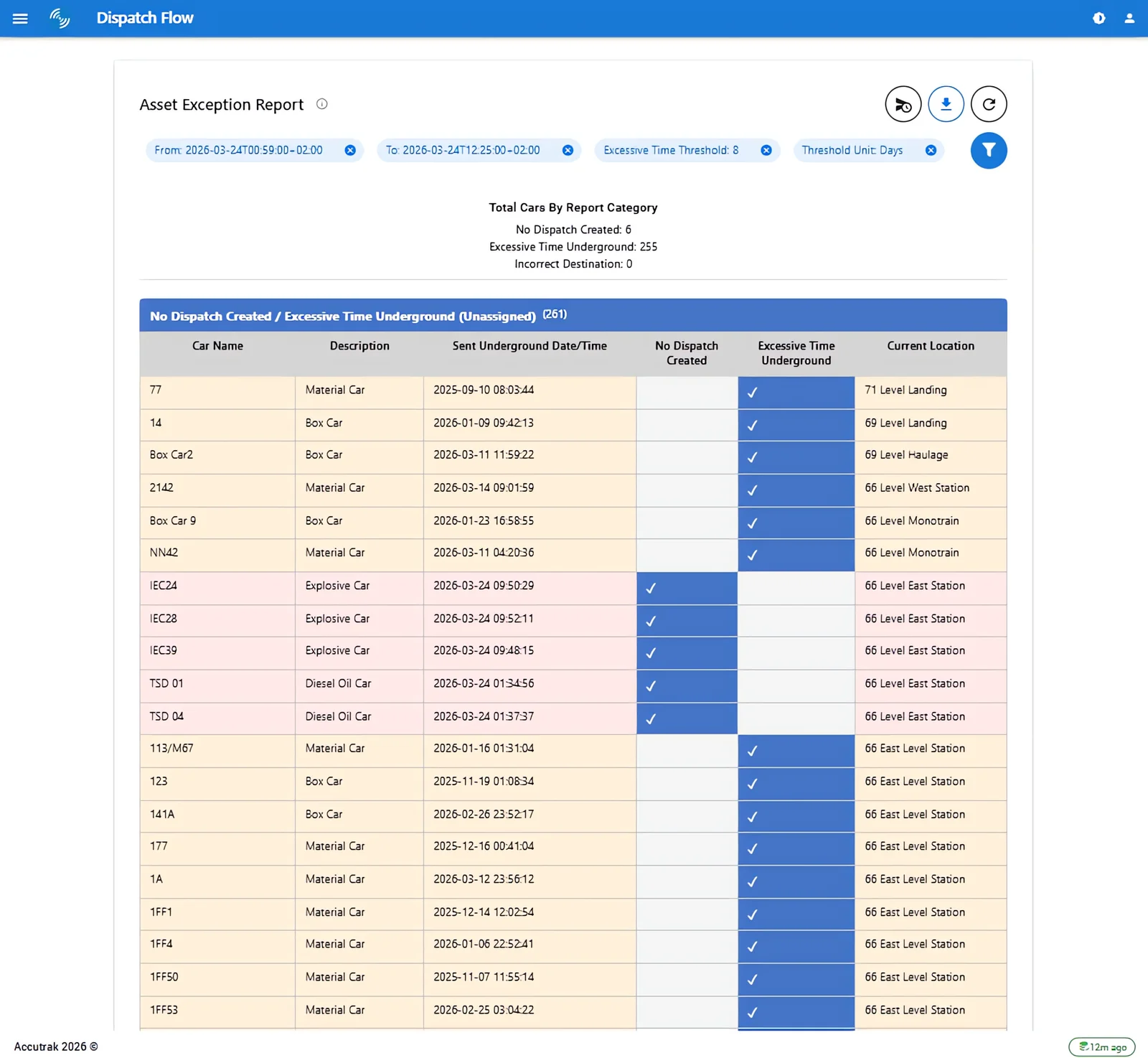
The trip analytics built on top of that tracking data added further depth. Turnaround times per car, time spent underground, whether a dispatched car reached its intended destination and which cars were lingering underground without a recorded dispatch, all of this became visible and reportable. Cars sitting underground for excessive periods could be flagged automatically, and accountability for unassigned or misdirected cars could be traced back to the responsible party.
The Gap: Surface Management
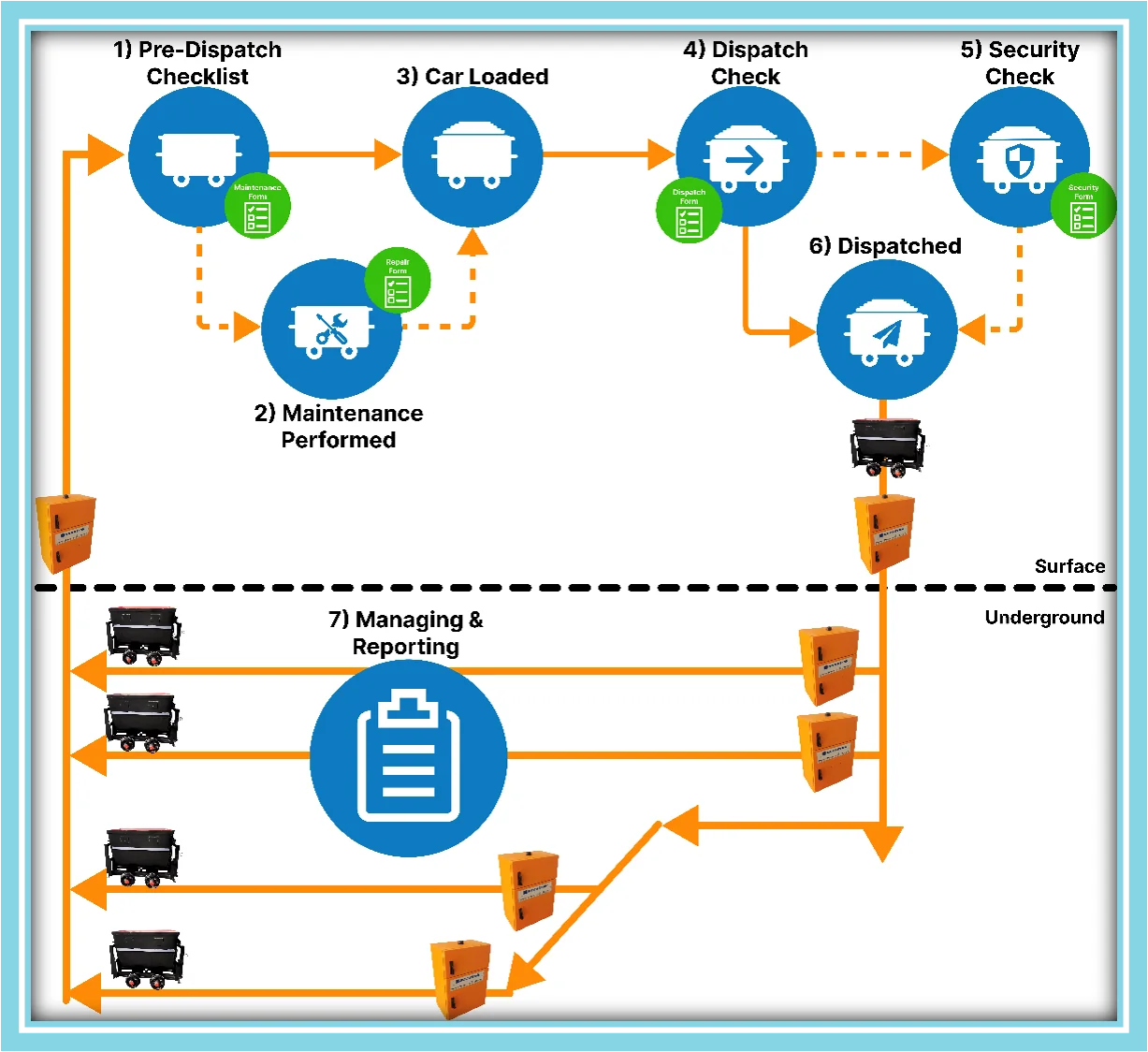
With underground visibility well established, the mine's attention turned to the surface. Before any material car goes underground, a series of critical processes must take place: a pre-dispatch maintenance inspection, any identified maintenance work, loading, a dispatch check to confirm the correct destination, and a post-loading security inspection. These processes were happening, but they were entirely manual, paper-based and disconnected from the tracking system.
There was no way to confirm that every car that went underground had completed the required inspections. Non-compliant cars were not being caught before dispatch. Maintenance issues were accumulating undetected. The mine wanted to digitise these surface processes and integrate them directly into the Accuchip system so that no car could go underground without a complete, verifiable record.
What We Deployed
Accutrak Group augmented the existing Dispatch Flow progressive web app to cover the full surface management process. Tablets were assigned to key stakeholders at each stage on surface: maintenance teams, banksmen, dispatch controllers and security personnel. The app was designed to function reliably in environments with poor or intermittent connectivity, ensuring no step in the process was skipped due to signal issues.
For every car that went underground, the system now required and captured:
- A pre-dispatch checklist completed by the maintenance team
- Any maintenance work performed, logged against the specific car
- Confirmation of material loaded and intended destination underground
- A dispatch check by the controller before the car was released
- A post-loading security inspection, with the inspector recorded
Every one of these steps was linked to the car's unique identifier and to the specific trip that car subsequently completed underground. The full lifecycle of each car, from surface preparation through to underground delivery and return, became a single connected record.
What the Mine Can Now See
Outstanding maintenance items are surfaced in a live dashboard, showing each asset, its current location, how many days the maintenance item has been outstanding, and whether the car is still permissible for use. Cars approaching or exceeding compliance thresholds are flagged before they become a risk.
Security checks that have not been completed are tracked in a separate view, showing the reference, asset, responsible owner, origin, intended destination and the date the check was created. Nothing slips through.
The Result
Every material car going underground now carries a complete, auditable surface record. Maintenance issues and non-compliance are identified at the point they occur rather than discovered after the fact. The mine has full accountability across the surface management process, integrated into the same system that tracks the car through the entire underground operation.
What had been a critical but invisible gap, the managed handover of each car from surface preparation to underground dispatch, is now the most visible part of the operation.
"For every car that goes underground, the exact maintenance inspections, dispatch and security checks are performed and linked to each unique trip that car completes. Maintenance and non-compliance issues are quickly identified."
Related products: Accuchip
Controlling High-Value Ore Haulage on Public Roads
Gold Mining | South Africa
The Challenge
In many gold mining operations in South Africa, ore is not processed at the mine where it is extracted. Instead, it is transported by road truck between multiple mining facilities and centralised processing plants, often across public roads shared with other traffic. The payloads involved carry extreme financial value, making every trip a significant exposure from both a security and an accountability standpoint.
The operation faced two compounding problems. First, there was no reliable mechanism to verify that the material that left the source facility actually arrived at the destination in full — missing machines, unexplained diversions and unreconciled tonnages were recurring issues. Second, management had no live view of the fleet while it was on the road. If a truck deviated from its approved route, stopped in an area it should not have been in, or tipped its load at an unauthorised location, no one would know until the shift was over, if at all.
What We Deployed
Accutrak Group deployed two integrated systems across the operation: Roadgaze on every truck in the fleet, and In-Motion Weighbridges at both the source and destination facilities. The two systems were fully integrated, combining real-time fleet intelligence with accurate, automated tonnage accounting on every trip.
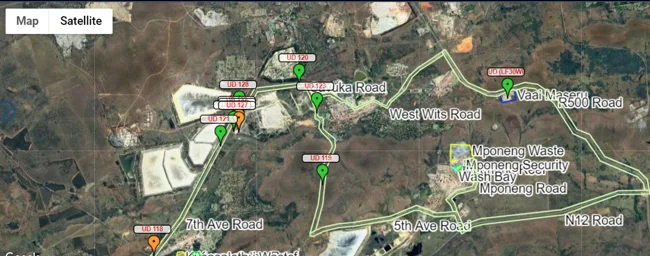
Live Fleet Control with Roadgaze
Roadgaze provided continuous, real-time GPS tracking of every truck from the moment it left the source facility to the moment it returned. Trip counts, loading durations, travel times and utilisation were visible throughout the shift, giving management an accurate, live picture of daily productivity without relying on manual reports.
The security layer went further. Three specific events triggered automatic push notifications to the relevant stakeholders the instant they occurred:
- Tipping outside an approved area — any bucket tip recorded at a location not on the approved destination list generated an immediate alert.
- Route deviation — any truck that left the approved road corridor was flagged in real time, with the deviation location and duration recorded.
- Unauthorised standstill — any truck stationary for more than five minutes in an area outside an approved stopping zone triggered an alert to the designated contact.
Each event was logged with a timestamp, GPS coordinate and truck identifier, creating an auditable security record for every trip completed.
Payload Reconciliation with In-Motion Weighbridges
An In-Motion Weighbridges unit was installed at the exit of the source facility and at the entrance of the destination facility. Each truck was weighed at operating speed as it passed through, eliminating queuing delays while capturing an accurate payload for every trip. Because both weighbridges fed data directly into the Roadgaze platform, every trip carried a complete record: source weight, destination weight, route taken and time in transit.
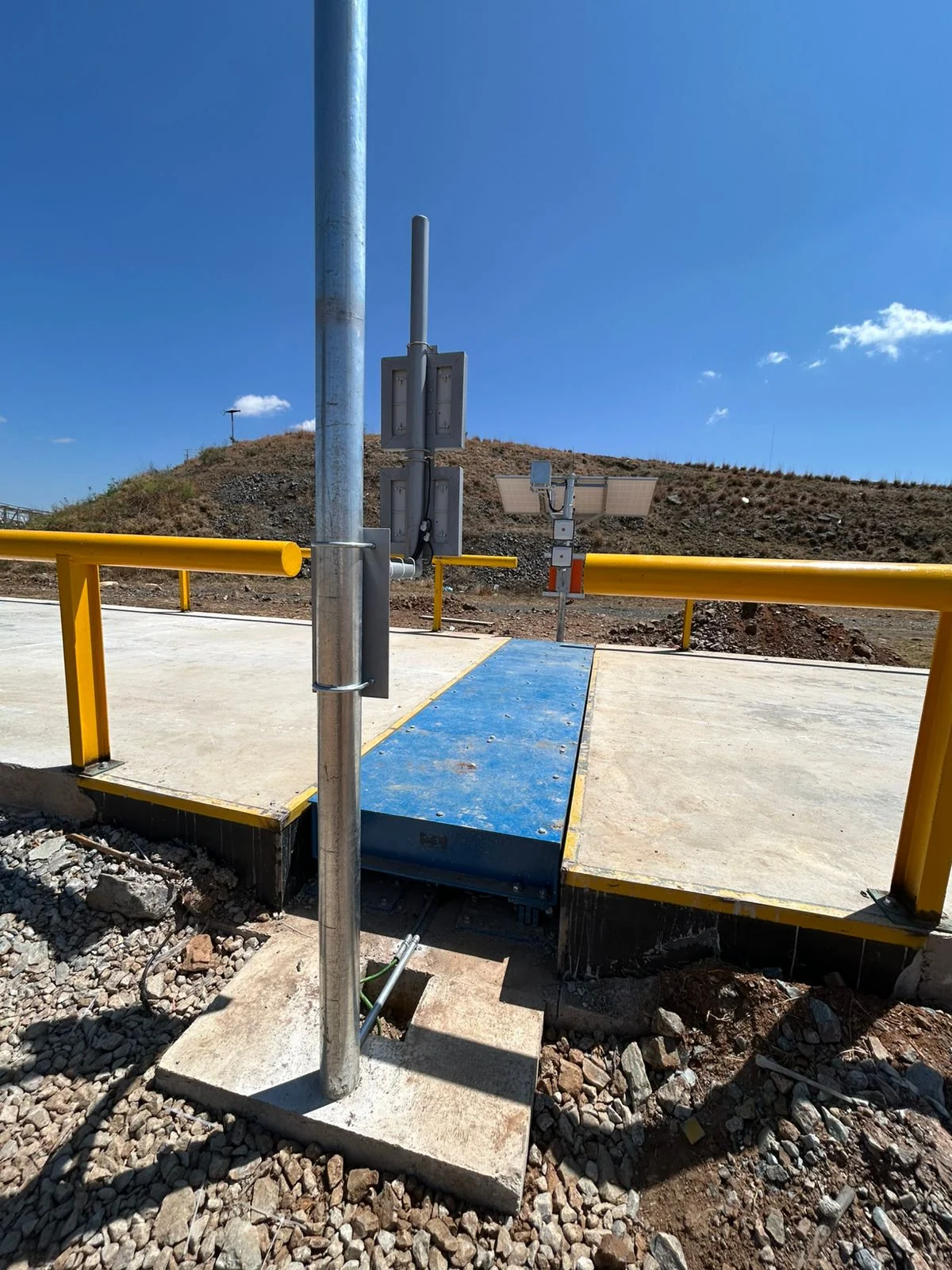
Source-to-destination tonnage reconciliation became automatic. Any discrepancy between what was loaded at the mine and what was received at the plant was surfaced immediately in the system, rather than discovered days later in a monthly audit. The combination of route tracking, security alerts and weighbridge data meant that any incident of missing material could be investigated with a complete, timestamped record of exactly where the truck had been.
The Result
Management gained live oversight of a fleet that had previously been invisible the moment it left the gate. Security incidents that had gone undetected for entire shifts were now generating alerts within seconds. Payload reconciliation between source and destination closed the accountability gap that had allowed tonnage discrepancies to accumulate undetected.
The operation now has a complete, integrated record of every trip: what was loaded, the route taken, any security events that occurred, and what was received at the plant. The financial exposure of high-value road haulage is matched by the visibility required to protect it.
"Every trip now carries a complete record: source tonnage, destination tonnage, approved route adherence and a timestamped log of every security event. The exposure of high-value ore haulage on public roads is finally matched by the visibility needed to manage it."
Related products: Roadgaze | In-Motion Weighbridges